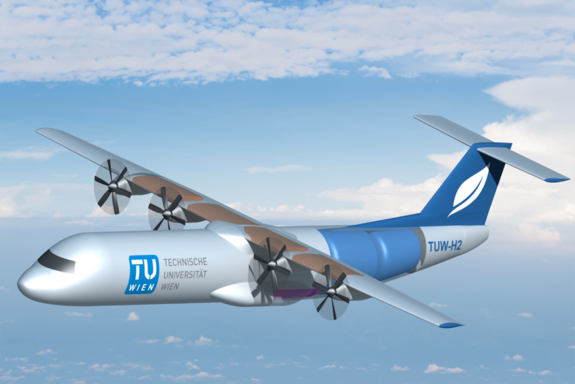
What will the aeroplane of the future look like? How can flying become more sustainable? And which technologies will transform the aviation industry? The new Master’s programme in Aeronautical Engineering provides the technical expertise needed to help find the answers to these questions.
Aeronautical Engineering: a field with many prospects
Aeronautical Engineering encompasses far more than just the construction of aeroplanes. The discipline deals with the development, testing, operation and maintenance of a wide variety of aircraft: from commercial and general aviation aircraft, through gliders and helicopters, to drones and other aircraft falling under the umbrella of ‘Advanced Air Mobility’.
TU Wien is offering Austria’s first university-level Master’s programme in Aeronautical Engineering with the new programme. It builds on the Bachelor’s degree programmes in Mechanical Engineering, opens an external URL in a new window or Industrial Engineering - Management, opens an external URL in a new window and combines a solid foundation in engineering science with a specialisation in aeronautical engineering.
“If you’re fascinated by aviation and want to find out how it’s even possible for aeroplanes with a take-off mass in the three-figure tonne range to fly at all, then you’ve come to the right place,” says Martin Berens, who coordinated the development of the programme.
Small teams, international perspectives
Students learn in relatively small teams, enabling them to work closely with lecturers and fellow students. At the same time, the degree programme combines the traditional fundamentals of mechanical engineering with specialised aspects of aeronautical engineering – ranging from aerodynamics and lightweight construction, through propulsion technology and materials science, to systems engineering.
International experience can also be easily integrated into the degree programme: a semester abroad can be incorporated into the individual study plan without losing any study time. TU Wien supports students in this through Erasmus+ and other programmes.
For Martin Berens, TU Wien is a particularly exciting place for aspiring aeronautical engineers, not least because of its research focus. Students benefit from this research, which includes work on efficient aircraft propulsion systems and transmission systems for helicopters and fixed-wing aircraft. At the same time, there are partnerships with numerous companies in the Austrian aviation industry, offering exciting career prospects.
Rethinking aviation
Aviation is facing major changes. A key challenge is to reduce the climate impact of flying, for example, through sustainable fuels, more efficient propulsion systems and improved aerodynamics. At the same time, electric and hydrogen-electric propulsion systems, as well as Advanced Air Mobility, are opening up new possibilities for air travel.
It is not always necessary to develop entirely new aircraft for technical improvements to have an impact. One example is winglets fitted to the wingtips: this relatively minor change to the wing geometry can reduce an aircraft’s fuel consumption by several per cent. There have also been significant developments in propulsion systems in recent years. Electric aircraft have now become established in general aviation and could also prove of interest for other areas of application in the future.
“What excites me most is that a design supposedly as mature and optimised as a passenger aircraft has to – and indeed can – be reimagined in light of new constraints relating to climate impacts,” says Berens. “Established solutions are being called into question, and many new engineering challenges must be overcome to realise new and disruptive concepts.”
Digitalisation is also transforming the industry. Artificial intelligence is already capable of analysing large volumes of measurement and image data and will play an even greater role in the future in areas such as flight route planning and aeronautical research. For aspiring aeronautical engineers, this means they will be working in an industry where established technologies are being further developed whilst, at the same time, entirely new solutions are being tested.
Engineers for the aviation industry of tomorrow
Graduates of the Master’s programme in Aeronautical Engineering have a wide range of career prospects: from research and development, through design, calculation and testing, to certification, production and project management. Relevant roles can be found at aircraft manufacturers, systems and components suppliers, airlines, maintenance organisations and regulatory bodies.
The Austrian aviation industry has grown steadily over recent decades. As a result, there is a high demand for qualified specialists. “The demand is and remains very high,” summarises Berens. Furthermore, the skills acquired are not limited exclusively to aviation: knowledge of areas such as lightweight construction, materials science, fluid mechanics and systems engineering is also in demand in other technical sectors.
Important information for prospective students: As the Master’s programme builds on the fundamentals of mechanical engineering, a relevant Bachelor’s degree is a prerequisite. Those who have completed a different undergraduate degree must meet the required academic admission criteria before commencing the Master’s programme, as conditional admission is not possible.
Without engineering, nothing’s possible
Martin Berens’s own enthusiasm for aviation began with gliding. He later studied aerospace engineering and aerodynamics. “Both have their appeal: the fascination of practical flying on the one hand, and solving exciting engineering problems on the other.”
For Berens, one thing is certain: “Aeronautical engineering is far more exciting today than it was 20 years ago. Take electrification, for example: we are in the midst of a phase where improvements in the weight and performance of components are opening up new fields of application. And this is being driven by engineers – true to the motto: ‘Without engineers, nothing gets done’.”
Further information on the curriculum, admission, programme structure and career prospects:
Master’s programme in Aeronautical Engineering at TU Wien, opens an external URL in a new window