Many key innovations of our time, ranging from high-performance electric motors and durable materials to quantum computers, rely on materials with tailored properties. These can be created, for example, through doping or alloying, whereby individual atoms in the crystal lattice are replaced by others. A team led by Andrej Pustogow and Ernst Bauer from TU Wien investigated exactly how the thermoelectric properties of a material can be improved through targeted substitution. They recently published their findings in the prestigious journal Nature Communications.
Heusler Compounds: properties ‘on demand’
The research focuses on the class of materials known as “Heusler” compounds. These are characterized by their great structural variability: many different elements can be incorporated into their crystal lattice, allowing their properties to be modified over a wide range. “It is precisely this versatility that makes Heusler compounds an ideal ‘building block’ for new functional materials,” explains Ernst Bauer.
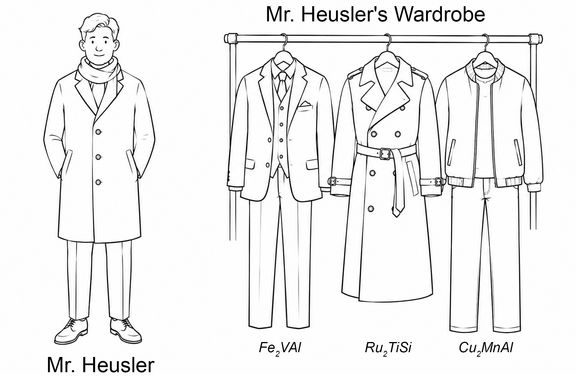
“You can think of the modifications as changing outfits,” says Andrej Pustogow. “Inside, it’s always the same person. But what changes, depending on the occasion or function, is the outfit.” Applied to materials research, this means that while all related materials have the same crystal structure, one can swap out the atoms at will and thus obtain functionality ‘on demand’.
New thermoelectric materials
A particularly promising field of application for Heusler compounds is thermoelectricity. Thermoelectric processes are those in which heat is directly converted into electrical energy. Such materials could, for example, utilize waste heat from industrial processes or vehicles, thereby contributing to increased energy efficiency. Conversely, thermoelectric materials can also be used for cooling via an electric current, for instance in compact refrigerators or in PCR devices that require rapid temperature changes.
“In both cases, achieving high thermoelectric efficiency requires materials that possess both high electrical conductivity and low thermal conductivity. In our current work, we have found a method to create barriers to heat flow that are invisible to the electrical charge carriers,” explains Fabian Garmroudi, one of the study’s two first authors. Illia Serhiienko, co-first author, adds: “We have thus set a new record with the highest thermoelectric performance ever measured in Heusler materials—and we are far from reaching the limit!”
No stone is left unturned
The effect of such atomic changes, as the team makes them through doping or alloying, can be enormous and is visible in many areas of our daily life. “We literally left no (elementary building) block on its place. Starting with the extensively studied compound Fe2VAl, we replaced the iron atoms with ruthenium, vanadium with titanium, and aluminum with silicon,” says Andrej Pustogow. The result: Ru2TiSi, opens an external URL in a new window, a material with greatly improved thermoelectric performance. If, in Fe2VAl, all iron atoms are instead replaced with vanadium, V3Al yields an even more constant resistance than the much-cited material Constantan, opens an external URL in a new window. The decisive progress is not only the improved performance, but above all the understanding of the underlying physical mechanisms, which are also transferable to other materials.
New materials classes are taking over the “wardrobe”
Andrej Pustogow’s team is also exploring new ways to improve the thermoelectric properties of materials beyond semiconducting Heusler compounds. With the introduction of a new class of materials, metallic thermoelectrics, opens an external URL in a new window, the team is adding—in the context of the wardrobe analogy—not just another closet to the field of research, but an entire shopping street.
The award of an ERC Grant, opens an external URL in a new window underscores the relevance of this field of research.
Original publications
Garmroudi, F., Serhiienko, I., Parzer, M., Pustogow, A., Podloucky, R., Mori, T., & Bauer, E. (2026). Orbital-selective band engineering realizes high zT in p-type Ru2Ti1− xHfxSi full-Heusler thermoelectrics. Nature Communications, 17(1), 2878.
Garmroudi, F., Parzer, M., Mori, T., Pustogow, A., & Bauer, E. (2025). Thermoelectric Transport in Ru 2 Ti Si Full-Heusler Compounds. PRX Energy, 4(1), 013010.
Parzer, M., Garmroudi, F., Riss, A., Mori, T., Pustogow, A., & Bauer, E. (2025). Mapping delocalization of impurity bands across archetypal Mott-Anderson transition. Physical Review Letters, 135(6), 066302.
Contact
Prof. Andrej Pustogow
TU Wien
Functional and Magnetic Materials Research Group
+43 1 58801 131 28
andrej.pustogow@tuwien.ac.at
Prof. Ernst Bauer
TU Wien
Functional and Magnetic Materials Research Group
+43 1 58801 131 44
ernst.bauer@tuwien.ac.at