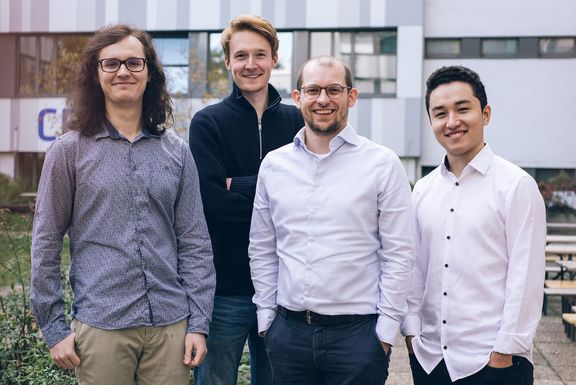
How can conflicts and polarization in social networks be better understood? A research team led by Stefan Neumann has developed a new method that does not assume rigid sides, but models opinions as overlapping intervals. Using political data from Germany and other networks, the work shows how conflict structures can be interpreted at the group level.
Polarization beyond individual comments
Social and digital networks are characterized by conflict, escalation, and polarization. Individual problematic content such as insults or misinformation can often be identified relatively easy. However, analysis at a higher level is more difficult: Which groups are in conflict with each other, and how are these conflicts structured?
This is precisely where Stefan Neumann and his team come in. “We don't examine social networks at the level of individual persons, but rather look at interactions between groups,” explains Neumann. The goal is to better understand which areas of opinion are compatible with each other—and where understanding becomes increasingly difficult.
A new model represents opinions as intervals
In the past, polarization was often analyzed along two strong poles, as seen in the US political system, for example. However, many social debates do not follow a clear binary pattern, but rather represent a spectrum of different positions.
Instead of constructing fixed sides, the new algorithm therefore models so-called opinion intervals. “Research shows that people with positions within a certain range can interact well. Beyond this range, however, acceptance decreases,” says Neumann. The more different the opinions are, the more difficult it becomes to find common ground. However, shared topics can help people engage in dialogue with one another and also be more open to other opinions.
From politics to the Bitcoin network
To evaluate the method, it was applied to several real-world data sets. One focus is on political votes in the German Bundestag. Voting data from 1,480 members of parliament over a period of 13 years was analyzed. Compared to highly polarized two-party systems, the multi-party system allows for a more differentiated analysis. Networks from the Bitcoin environment were also examined. Trust and conflict relationships play a central role here, for example in the question of which actors are trusted to implement technical processes correctly. Here, too, it becomes apparent that the formation of groups should not be seen strictly as polarization into opposing sides, but that it is better to think in terms of overlapping intervals. The contexts in which the algorithm can be used are correspondingly diverse.
“Another major advantage is data minimization: information about positive and negative interactions is sufficient to identify meaningful patterns,” emphasizes Stefan Neumann.
Highly relevant
The method originates from social network analysis and aims to produce easily interpretable results. This knowledge is particularly relevant for research into social cohesion, political communication, and platform dynamics.
At the same time, methods that work at the group level are considered less critical in terms of data protection than approaches that specifically analyze or influence individuals.
The results were presented at the Thirty-ninth Annual Conference on Neural Information Processing Systems, the world's largest conference on machine learning. It was selected for an oral presentation as one of only 77 out of 5,290 accepted and 21,575 submitted contributions – a special recognition in a highly competitive field of research.
Original publication
Blohm, P., Chen, F., Gionis, A., & Neumann, S. Discovering Opinion Intervals from Conflicts in Signed Graphs. In The Thirty-ninth Annual Conference on Neural Information Processing Systems. https://openreview.net/pdf?id=zJdutIT6vT, opens an external URL in a new window
Contact
Prof. Stefan Neumann
Research Unit Machine Learning
TU Wien
stefan.neumann@tuwien.ac.at
Text:Sarah Link